
For decades, the ultimate flex in the agency world was physical mass. Success was measured by square footage in trendy downtown lofts, ping-pong tables in the breakroom, and an ever-expanding “Meet the Team” page. Pitching a Fortune 500 client or a heavily funded startup meant walking into the boardroom with an army of Account Managers, Creative Directors, and Technical Leads to prove you had the sheer horsepower to handle their account.
That era is over.
Today, a radical paradigm shift is rewriting the rules of the digital marketing and development industry. The massive, bloated, 50-person agency is losing ground. They are being out-maneuvered, out-priced, and out-pitched by a new breed of competitor: the “Invisible Agency.”
These are ultra-lean micro-agencies—often run by solo founders or a tiny core of two to three strategic partners. On the front end, they present as elite, hyper-specialized consultancies. On the back end, they are delivering massive, complex, multi-channel enterprise campaigns that seemingly require a staff of dozens.
How are they doing it? They have stopped building expensive in-house teams and started leveraging sophisticated, white-labeled backend infrastructures.
1. The Overhead Trap: Why the “Big Agency” Model is Breaking
To understand why the solo founder is winning, you have to understand the inherent vulnerabilities of the traditional scaling model.
When a standard agency decides to scale its recurring revenue, the immediate reflex is to hire in-house talent. You land a major web development retainer, so you hire a Senior Laravel Developer. You sign three new SEO clients, so you bring on a full-time SEO Copywriter and an Outreach Specialist.
This model introduces catastrophic financial and operational pain points:
The “Bench Time” Profit Bleed
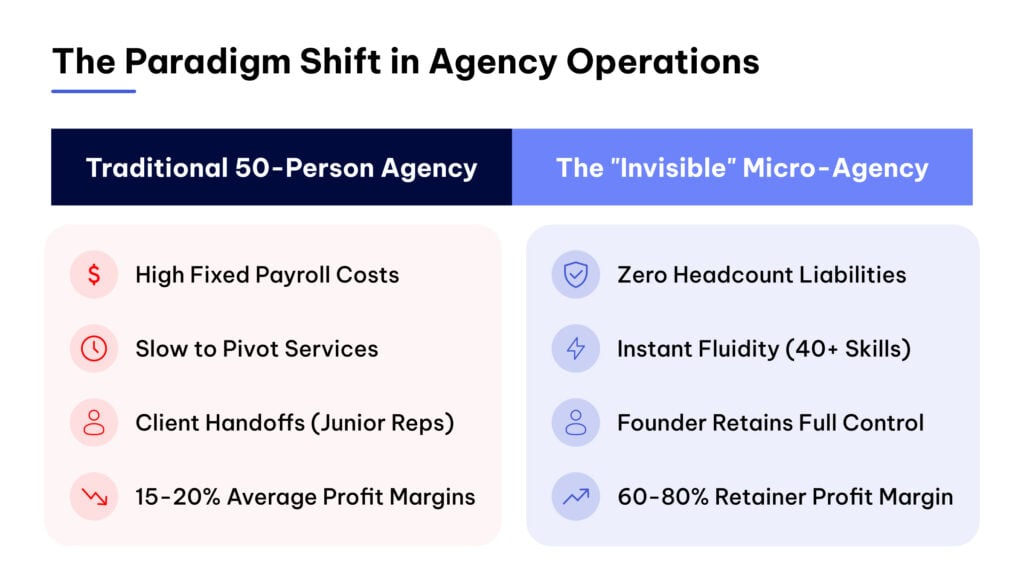
In-house employees are a fixed cost applied to a highly variable revenue stream. When your developers and designers are actively billing hours to a client, you are profitable. But what happens when a project stalls because the client is delaying approvals? What happens during the holiday slowdown? Your staff goes “on the bench.” You are suddenly paying premium salaries for zero output, rapidly cannibalizing the profits you made during the busy months.
The Management Tax
As headcount grows, the founder’s role shifts. You stop being the visionary strategist that your clients hired and become a full-time babysitter. You spend your days managing HR disputes, tracking paid time off, and conducting performance reviews. The larger the agency, the further the founder is removed from actual revenue-generating activities.
The Pricing Disadvantage
To cover the massive overhead of office space, software seats, benefits, and idle bench time, traditional agencies are forced to artificially inflate their retainers. They aren’t charging for the value of the work; they are charging to keep their own lights on.
“The modern client doesn’t want to pay for your ping-pong table. They want to pay for results. The agency that can deliver those results with the least amount of operational bloat wins.”
2. The Pitch Room Paradox: What Clients Actually Want
A fascinating trend has emerged in corporate procurement: clients are experiencing “Big Agency Fatigue.”
When a brand hires a 50-person firm, they are usually sold by the charismatic CEO or the brilliant Creative Director. However, the moment the ink dries on the contract, the account is immediately handed off to a junior account manager. The strategic genius they thought they bought is nowhere to be found.
This is the Solo Founder’s ultimate advantage.
Clients crave direct, unfiltered access to the principal strategist. They want the person pitching the vision to be the person steering the ship. The micro-agency delivers this beautifully. The solo founder remains the singular point of contact, acting as a Fractional CMO or high-level strategic partner.
But there is a catch. The client still expects full-service, enterprise-grade execution. They want custom web applications, daily social media management, premium video editing, and complex automated funnels.
If a solo founder tries to fulfill this by manually managing ten different freelancers on Upwork, they will burn out in a month. This is the Oversell Panic—the terrifying moment you win the massive contract and realize you have no idea how you are going to fulfill it.
To solve this, the Invisible Agency doesn’t use freelancers. They use a unified backend engine.
3. The Blueprint of the Invisible Agency: Enter All-In-One WorkForce (AIO)
The secret to out-pitching a 50-person firm is walking into the room with 50-person capabilities, without carrying 50-person liabilities.
Elite solo founders are achieving this by integrating All-In-One WorkForce (AIO) as their exclusive, white-labeled fulfillment partner. AIO isn’t a freelance marketplace; it is a massive, highly structured production department that sits entirely out of sight, executing the founder’s strategy flawlessly.
Here is how AIO structurally empowers the Invisible Agency:
A. Total Service Fluidity (The Hour Credit System)
When pitching a comprehensive digital transformation, a solo founder needs to promise everything from UI/UX design to advanced database architecture to daily administrative data entry.
With AIO’s Universal Hour Credit (HC) system, the founder isn’t sweating over hiring different specialists. They simply purchase global capacity that can be instantly deployed across over 40 distinct services.
- They can deploy credits for a Premium Service (1.5 HC/hr) to build a complex React application.
- The next day, they can pivot those same credits to a Standard Service (1.0 HC/hr) for graphic design.
- Finally, they can deploy a Virtual Assistant (0.8 HC/hr) to handle the repetitive client onboarding data entry.
The founder can confidently say “Yes” to any client request, knowing their backend can instantly pivot to fulfill it without onboarding new talent.
B. The End of Margin Bleed (5-Minute Micro-Tracking)
Traditional freelancers kill margins by rounding up their hours. A 10-minute task is billed as a full hour. AIO eliminates this completely with 5-minute micro-tracking.
If an agency client requests a rapid “fire drill” update to a landing page, and the AIO developer executes it in 15 minutes, the solo founder is billed for exactly 15 minutes of execution. Combined with AIO’s transparent, wholesale rates of $10–$15 per hour, the Invisible Agency achieves staggering 60% to 80% profit margins that traditional bloated firms can only dream of.
C. True White-Label Security
The magic of the Invisible Agency relies on the illusion of seamless internal capacity. AIO operates with 100% confidentiality. From the client’s perspective, the high-quality code, the stunning graphics, and the perfectly optimized copy are all coming directly from the solo founder’s internal “team.” With the capacity to deliver over 12,000+ hours per month, AIO provides institutional stability. Even if an individual developer gets sick, AIO’s internal redundancy ensures the project continues without the agency founder or the client ever knowing there was a hiccup.
4. The Future Belongs to the Strategist
We are entering the era of the “Leveraged Founder.”
Execution is no longer a unique value proposition. Anybody can find a developer or a designer. The true value of a digital agency in 2026 and beyond lies entirely in strategy, brand positioning, and client relationships.
When you strip away the administrative nightmare of managing fragmented gig workers, and when you remove the financial terror of meeting a massive in-house payroll, you are free to focus 100% of your energy on high-leverage growth.
You can spend your week closing six-figure retainers, consulting with enterprise leadership, and designing brilliant campaign architectures.
The 50-person agency is a dinosaur, suffocating under the weight of its own operational bloat. The future belongs to the lean, the agile, and the invisible. By plugging your strategy into the hyper-efficient, micro-tracked backend of All-In-One WorkForce, you don’t just build an agency—you build an endlessly scalable, highly profitable machine.