
For years, the playbook for scaling a digital agency looked remarkably straightforward: win a new client, calculate the deliverables, and head straight to a freelance marketplace to patch together a project team. On paper, the gig economy promised the ultimate operational utopia—on-demand talent, zero payroll liability, and absolute geographic flexibility.
But ask any agency founder who has managed a scaled portfolio using a patchwork of independent contractors, and they will tell you a very different story.
What began as a strategy for lean growth quickly devolves into a high-stakes game of Freelancer Roulette. You spin the wheel on every new project, praying that your developer doesn’t ghost, your graphic designer interprets the brief correctly, and your copywriter delivers on time.
The true cost of relying on siloed gig workers isn’t just the line-item invoice you pay them; it’s the massive, invisible operational drag that quietly cannibalizes your agency’s profit margins, destroys your culture, and caps your ability to scale.
1. The Fragmentation Tax: The Invisible Drain on Agency Leadership
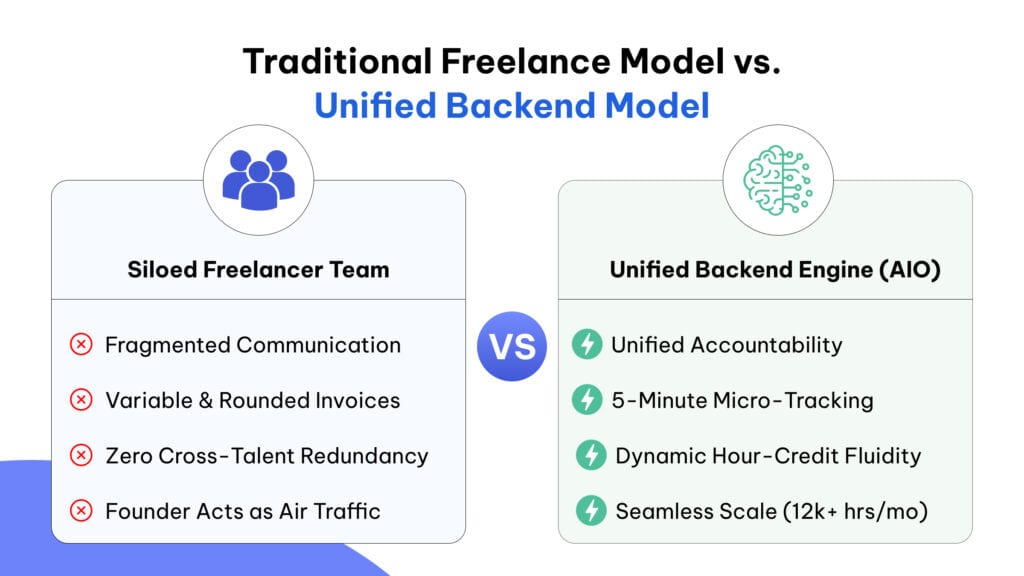
When you build an agency infrastructure out of siloed freelancers, you aren’t just buying execution—you are unconsciously taking on the role of a full-time air traffic controller.
Independent contractors operate in silos. They have different communication preferences, disparate workflows, varying time zones, and zero institutional alignment with your agency’s long-term vision.
The Management Bottleneck
Consider the daily reality of managing a standard web development and launch campaign using siloed talent:
- Your UI/UX Designer is in London, working inside Figma but refusing to check Slack.
- Your MERN Stack Developer is in Manila, operating exclusively via email with a 12-hour time difference.
- Your SEO Copywriter is a domestic freelancer who only communicates via text and works asynchronously on weekends.
As the agency owner or account director, you become the single point of failure. You must translate the designer’s vision to the developer, copy-paste assets across three different project management tools, and bridge the massive communication gaps. This constant context-switching generates a severe operational bottleneck. You aren’t scaling an agency; you are managing chaos.
“If you owe your bank a hundred dollars that’s your problem. If you owe the bank a hundred million, that’s the bank’s problem. Similarly, if you manage one freelancer, that’s an asset. If you manage ten siloed freelancers, you don’t own an agency—they own your schedule.”
2. The Three Hidden Liabilities of the Gig Economy
While freelance platforms market themselves as a frictionless way to source talent, they inherently harbor three systemic liabilities that run counter to agency growth.
A. Quality Asymmetry
Siloed gig workers deliver wildly inconsistent quality. A freelancer may have a flawless portfolio on Upwork or Fiverr, but their output is entirely dependent on their current workload, personal life, and immediate financial motivations. Because they are not embedded in a structured system with internal quality assurance (QA), your agency’s reputation is placed entirely in the hands of an unverified individual. You end up paying your core team to rewrite code, redesign assets, and fix sloppy executions—effectively paying twice for a single deliverable.
B. The Vulnerability of “Ghosting”
In the freelance world, loyalty is transactional and ephemeral. If a siloed contractor receives a higher-paying direct client or experiences personal burnout, your project is instantly compromised. The sudden disappearance of a critical developer mid-sprint can cause an agency client “fire drill,” forcing your core team into panic mode, triggering weekend overtime, and fracturing client trust.
C. The Margin Bleed of Rounded-Up Hours
Most independent contractors bill in broad, imprecise blocks of time. A task that took 35 minutes is frequently rounded up to a full hour on the invoice. Over a month, across multiple freelancers and projects, this rounding error creates significant profit bleed. You find your agency paying for unworked, un-trackable idle time that directly erodes your project margins.
3. Shifting from “Gig Workers” to Infrastructure Mindset
To break past the operational ceiling and securely cross the $10k, $50k, or $100k MRR thresholds, successful digital agencies are abandoning the gig-worker mentality entirely. They are replacing fragmented freelance networks with a centralized, white-labeled, fully integrated backend workforce partner.
True scale requires an ecosystem that provides human redundancy, predictable pricing, and centralized accountability. This is precisely why elite agencies partner with All-In-One WorkForce (AIO).
Instead of playing freelancer roulette, agencies utilize AIO as a scalable, invisible engine that handles heavy-lifting execution seamlessly behind the scenes.
4. How All-In-One WorkForce (AIO) Eliminates the Hidden Costs of Scale
AIO is engineered specifically to eliminate the systemic frictions of traditional outsourcing, transforming execution from a chaotic variable into a predictable utility.
Slaying the Profit Bleed with 5-Minute Micro-Tracking
AIO completely disrupts traditional freelance billing architectures. Instead of dealing with ambiguous invoices and rounded-up hours, AIO utilizes precise 5-minute task tracking. You are billed exclusively for active execution time. If a specialized task takes 25 minutes, you pay for exactly 25 minutes. This structural precision plugs the leaks in your project margins, ensuring that every dollar spent translates directly into client-facing value.
Total Agility: The Universal Hour Credit (HC) Ecosystem
In a standard freelance setup, if you hire a specialized React developer but your pipeline suddenly shifts toward UI design or virtual assistance, you are stuck. You have to offboard talent, vet new contractors, and start the hiring cycle over again.
AIO solves this via a highly fluid Hour Credit (HC) system. Your agency purchases global capacity that can be instantly deployed across more than 40 distinct digital specializations.
- Need a Premium Developer (MERN, Laravel, advanced architectures) to solve a complex database bottleneck on Monday? Deploy your credits at a 1.5 HC/hr rate.
- Need a Graphic Designer or Digital Marketer to execute creative assets on Wednesday? Utilize your credits at a 1.0 HC/hr rate.
- Need a Virtual Assistant to handle data entry, client onboarding steps, or content migration on Friday? Deploy credits at a highly efficient 0.8 HC/hr rate.
This cross-disciplinary fluidity allows your agency to remain incredibly lean, pivoting your entire operational focus instantly without onboarding or offboarding a single human being.
Institutional Stability and White-Label Security
AIO doesn’t just offer isolated hands; it delivers institutional capacity. With the operational capability to handle over 12,000+ hours per month, AIO provides the redundancy that prevents agency burnout. If a team member assigned to your account faces an emergency, AIO’s integrated ecosystem ensures a seamless handoff without your deliverables skipping a beat.
Furthermore, the entire operation is strictly white-labeled. With secure, confidential workflows, live expert sessions, and dedicated client communication add-ons, your clients experience a flawless, premium full-service agency, entirely unaware of the massive backend engine powering the operation.
5. Strategic Conclusion: Stop Managing Tasks, Start Driving Growth
Every hour an agency founder spends chasing a freelancer down a Slack channel, debugging unverified code, or reconciling erratic invoices is an hour stolen from high-value activities: strategic client acquisition, brand positioning, and enterprise-level relationship building.
The gig economy promised freedom, but without structure, it delivers an administrative prison. To build a truly valuable, scalable agency asset, you must stop gambling on siloed talent.
By shifting your fulfillment to a transparent, micro-tracked, and hyper-flexible backend partner like All-In-One WorkForce, you secure top-tier execution ($10–$15/hr) while buying back your absolute focus. Step away from the roulette wheel and build your growth on a foundation of predictable infrastructure.